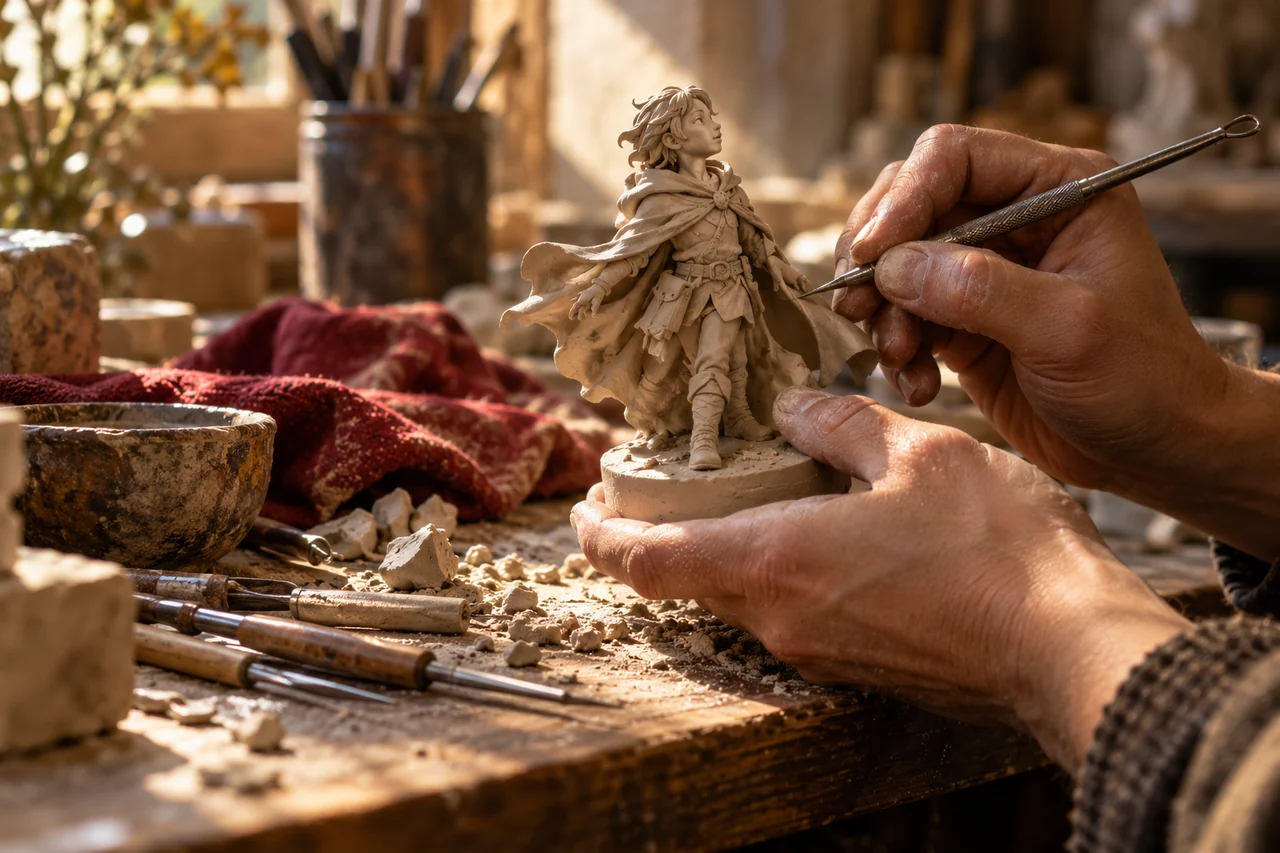
A small collectible is an interpretation of a character at a new scale. Simply reducing a detailed model can make the face unreadable, merge costume layers and leave important accessories too delicate. Begin with what makes the character recognizable, then translate those cues into forms that remain clear in the finished object. Selective simplification can preserve identity more effectively than literal reduction.
Identify the character’s strongest recognition cues
Choose a small set of features that a viewer should recognize immediately: head shape, hairstyle, costume silhouette, signature accessory or characteristic posture. Compare reference images and agree which cues are essential. A design with equal emphasis on every surface detail gives the viewer no clear starting point.
Create a simplified blockout at the intended proportions and inspect it as a silhouette. If recognition depends entirely on tiny emblems or paint markings, the major forms may need adjustment. Keep any stylistic exaggeration coherent with the brief. A realistic portrait and a stylized character require different degrees of interpretation.
Rebuild the detail hierarchy for the viewing distance
Group secondary elements into readable masses. Several small straps might become a clearer layered shape, while intricate hair can be organized into larger locks. Preserve the visual rhythm and meaning of the design rather than every individual line. Review these changes at a screen size comparable to the physical object.
Keep focal details more precise than supporting texture. Eyes, mouth and an important costume emblem may deserve a dedicated sample, while background fabric grain can remain understated. Too much uniform texture can obscure both expression and material differences. Use areas of calm to make the important features easier to find.
Prototype the translation through the full process
Make a representative head or torso sample and finish it using the planned method. Formlabs’ miniatures guide discusses both printing and post-processing because the final appearance depends on more than digital geometry. Evaluate the complete sample before assuming the smallest modeled detail will remain visible.
Check fragile projections and narrow gaps as part of the same review. Adjust them in a way that still belongs to the character, such as changing an accessory angle or merging a hidden contact. Explain the physical reason for those choices during approval. Manufacturing adaptations should be deliberate design decisions, not invisible compromises discovered after delivery.
Compare the collectible with its intended identity
Place the sample beside the approved character reference and ask what reads first. Does the pose communicate the right personality? Are the costume colors and major forms balanced? Can the expression be understood from the normal display distance? These questions are more useful than counting how many digital details survived.
Lock the approved interpretation before producing variants or additional sizes. A second scale may require its own adaptation rather than another uniform resize. Record which changes are intentional and preserve the physical proof. The successful miniature feels unmistakably like the character while acknowledging that a small crafted object communicates through a different hierarchy than a large illustration or screen model.
The key decisions.
- Prioritize a few strong recognition cues before adapting fine detail.
- Rebuild the hierarchy for actual viewing distance and physical scale.
- Approve a fully finished sample and treat new sizes as fresh design checks.
Sources & further reading
Primary references for the concepts discussed. Check the applicable documentation when planning implementation.