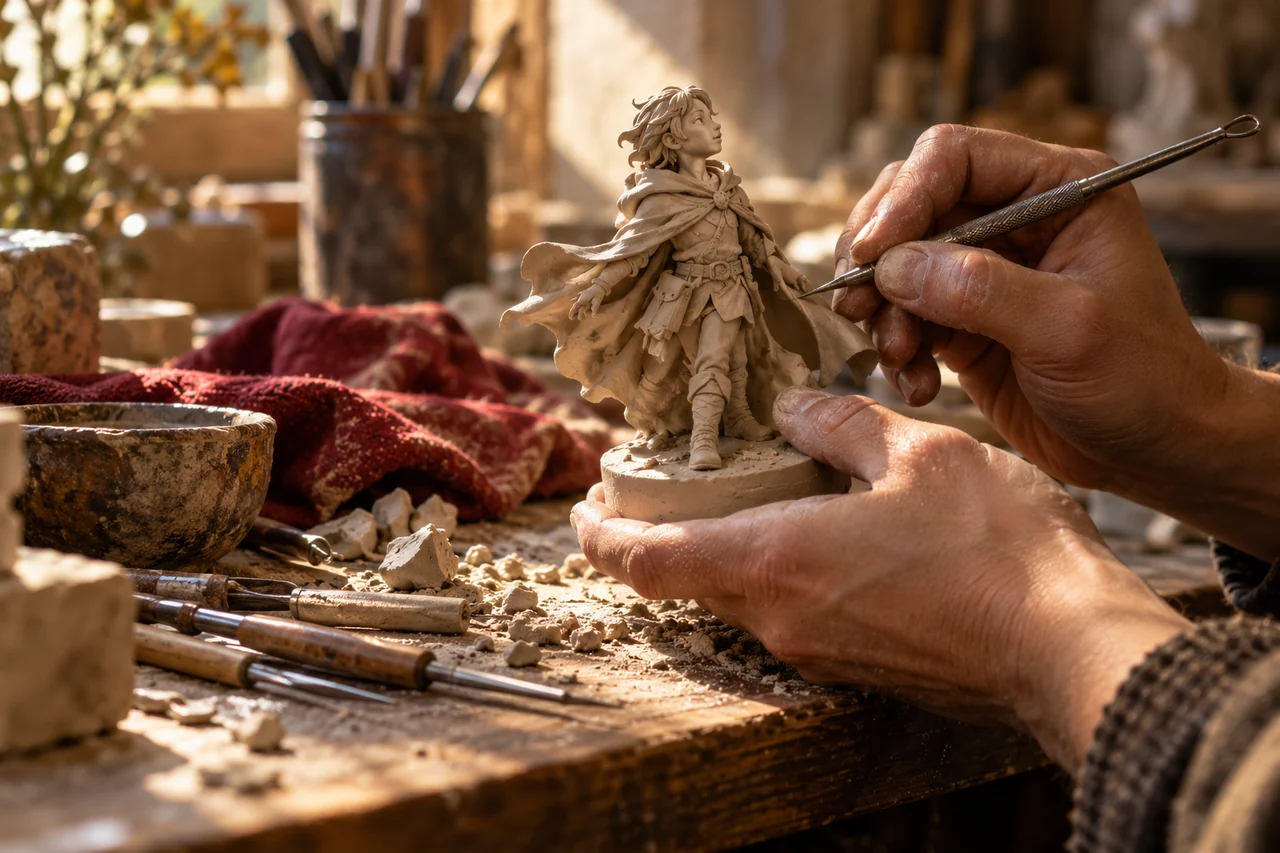
Pixel art can look perfectly controlled in an image editor and unstable in motion. Thin lines change thickness, backgrounds shimmer and the player appears to vibrate against the world. These problems often come from the relationship between the art grid, camera and output scale rather than the drawings. Establish that relationship early, using a small moving scene, so the visual style survives the way players actually experience it.
Choose the reference image grid
Define the resolution at which the world is designed and review how much of the scene it should show. This affects character size, environmental detail and the amount of information available to the player. Avoid selecting a tiny grid only for its nostalgic appearance without testing whether the intended gameplay remains understandable within it.
Separate the world image from interface requirements. A deliberately coarse game world does not mean all text and controls must use the same limited grid. Decide which elements scale together and which can render with different treatment. Godot's multiple-resolution documentation provides implementation context, but the visual hierarchy and supported screen arrangements remain design decisions for the project.
Test movement before drawing a large world
Build a scene with vertical lines, diagonal edges, a checker pattern and a simple animated character. Move the camera slowly in several directions and let the character cross the screen at different speeds. This exposes sampling problems that are difficult to diagnose in a richly illustrated background. Keep the diagnostic scene as a reference throughout production.
Review camera following and sprite positioning together. Snapping one while allowing the other to move differently can create relative jitter. A smooth camera may also conflict with an intentionally stepped visual grid. Choose the intended compromise through playback and control, not by applying a popular setting without examining how the whole scene behaves.
Handle scaling deliberately
Compare integer and non-integer output scales on representative displays. Scaling a pixel grid by uneven amounts can produce inconsistent apparent pixel sizes, while strict integer scaling can leave unused screen area. Decide how the game handles that tradeoff. Test windowed resizing and unusual aspect ratios so the presentation does not break outside a carefully chosen development window.
Inspect filtering and compression on the imported textures. Crisp edges may become soft or develop artefacts if the runtime settings do not match the art style. Avoid assuming source files retain their exact appearance after import. Check rotating or zooming elements separately, because transformations that work well for painted art may conflict with the chosen pixel aesthetic.
Review animation and background layers
Keep pivots consistent across animation frames and verify that the feet remain anchored when intended. Background parallax layers need their own motion review because different scroll rates can expose different sampling patterns. A distant layer that moves by tiny increments may shimmer even when the foreground looks stable. Simplify fine patterns where they do not survive the intended movement.
Before sign-off, run a short route at every supported scale and inspect both slow movement and fast transitions. Check interface readability, camera following and sprite alignment together. Document the approved grid and import conventions with the diagnostic scene. This gives future artists a practical way to test new content without rediscovering the same camera and sampling problems.
The key decisions.
- Define the world grid and interface scaling separately.
- Use a moving diagnostic scene to reveal sampling instability.
- Check camera, sprite pivots and parallax across supported output scales.
Sources & further reading
Primary references for the concepts discussed. Check the applicable documentation when planning implementation.